Here is the English translation formatted for your blog post, crisp and ready to publish:
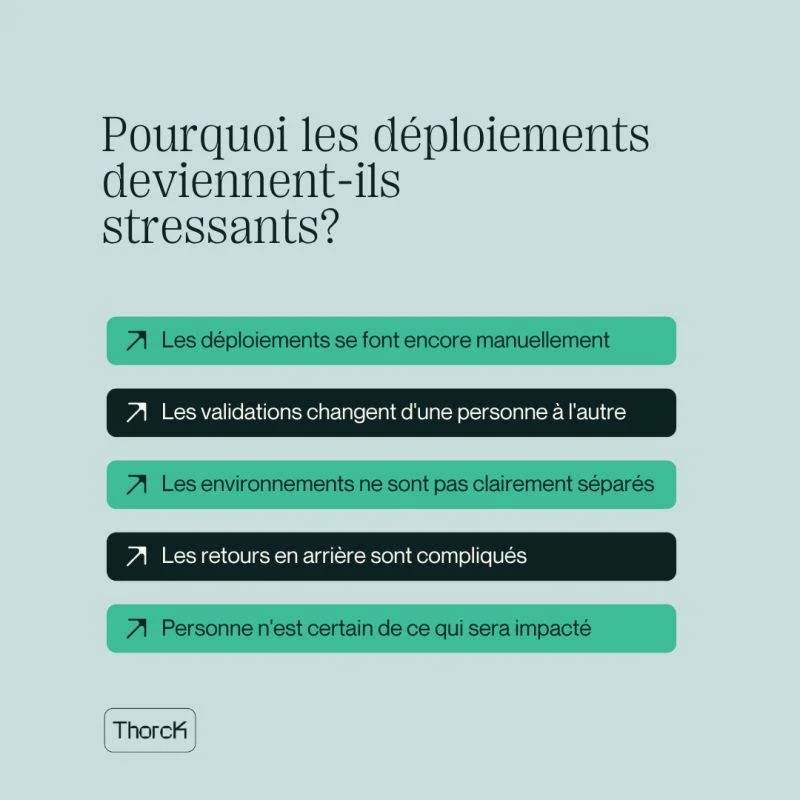
Why Do Deployments Become So Stressful?
It’s a classic scene: deployment time is approaching, and the tension starts to build. When a deployment turns into a source of stress for your team, the knee-jerk reaction is often to point fingers at the code. You hunt for the bug, the missing line of code, or the security flaw. Yet, the real problem usually lies elsewhere.
While the code might be the immediate trigger, the root causes of a chaotic deployment are typically operational.
The Invisible Culprits of Deployment Stress
Stress doesn’t originate from the code itself, but from the uncertainty surrounding it. When your processes are fragile, even the simplest release becomes a high-risk operation.
Here are a few of the invisible culprits:
Inconsistent validations: If approval criteria change from one person to another or from one release to the next, no one can ever be certain of the outcome.
Poorly defined environments: Confusion between development, testing, and production environments is a recipe for disaster. "It worked on my machine" is a phrase that should never be heard right before a release.
Over-reliance on key individuals: If a successful deployment hinges on the presence and memory of one or two senior developers, you have a critical dependency issue.
The Solution: Solid Processes for Lasting Confidence
Confidence in a platform isn’t built solely on good code—even though that remains essential. It is built above all on solid, documented, and repeatable processes.
A robust process makes deployments predictable. It eliminates guesswork and the fear of the unknown.
With a strong operational framework in place:
Teams know exactly what to do and when to do it. Every single step is clearly defined and planned.
Deployments become routine, not major events. Releases can be automated and executed anytime, completely stress-free.
Errors are caught earlier. Automated validations and standardized tests catch bugs long before they hit production.
Problem resolution is fast and effective. Teams know how to react, how to roll back, and how to communicate if something goes sideways.
In Conclusion
Don't let deployment stress paralyze your team and compromise your product quality. Invest in your operational processes. Automate what can be automated, standardize your validations, and document your workflows. That is how you build a culture of confidence and deliver value consistently and calmly.
Check out our LinkedIn post to join the live conversation!
👉 If your next deployment were scheduled for tomorrow morning, would you feel confident or nervous?
Your answer to that single question tells you everything you need to know about the strength of your processes.